REVIEW · GYEONGJU
Korail Day Trip to Gyeongju’s Unesco World Heritage Sites from Seoul
Book on Viator →Operated by Aju Incentive Tours · Bookable on Viator
One day in Gyeongju beats a week in Seoul. This Korail-style outing is built for speed and focus: you ride the KTX from Seoul, then spend the day hitting UNESCO sights in Gyeongju with a private guide and door-to-site transport. I love that the planning reduces the usual friction of timing and language, and you get a tight route across major Silla-era landmarks instead of a scattered self-guided day.
I also like how the stops are balanced—temple, royal tombs, an important museum, and an observatory—so the day doesn’t feel like one long “look and move on” routine. The main drawback to consider is the schedule length (about 9–10 hours) and the fact that meals aren’t included, so you’ll want a simple plan to stay comfortable until you’re back in Seoul.
If you’re the type who likes your history with real context—why it was built, who shaped it, and what archaeologists found—you’ll probably enjoy how this route connects the dots across centuries.
In This Review
- Key highlights at a glance
- KTX to Gyeongju: the smooth start from Seoul
- A private guide for max 2 people (and why that changes everything)
- Stop 1: Bulguksa Temple and Silla’s faith rebuilt after disaster
- Stop 2: Daereungwon Tomb Complex and Cheonmachong’s 11,526 artifacts
- Stop 3: Gyeongju National Museum (free) to connect the artifacts to the sites
- Stop 4: Cheomseongdae Observatory—astronomy as a 7th-century national treasure
- Time, food, and comfort: making the 9–10 hour day work
- Price and value: is $594.81 per person worth it?
- Who this Gyeongju UNESCO day trip suits best
- Should you book Korail Day Trip to Gyeongju’s UNESCO sites?
- FAQ
- How long is the day trip?
- Is this tour private?
- Where does pickup and drop-off happen in Gyeongju?
- Which UNESCO sites are included?
- Are admission tickets included?
- Are meals included?
- Do I need KTX train tickets?
- What’s the fitness level requirement?
Key highlights at a glance
- KTX-focused day plan that keeps you off the slow lane and on UNESCO time
- Private guide + private transportation for a small group pace (max 2 people)
- Bulguksa Temple with deep Silla background, rebuilt after major damage
- Daereungwon Tomb Complex and Cheonmachong Tomb’s astonishing artifact count
- Gyeongju National Museum (free) to make the tomb finds click
- Cheomseongdae Observatory tied to astronomy history and national treasure status
KTX to Gyeongju: the smooth start from Seoul
The whole trip is designed around Korail KTX. You get a rail segment that takes about two hours, and that matters because it turns a day trip from “almost too much travel” into “worth it, start-to-finish.” You’re also using a ticketed setup via mobile ticket, which is helpful when you want fewer surprises on the day.
One important thing: the tour concept mentions pre-booked round-trip KTX tickets, but the included list also says KTX train tickets aren’t included. So before you go, confirm what your booking covers for the train itself. You can still plan confidently for the route, but don’t let a ticket detail become your only real stress.
Also note the logistics: this experience includes pickup/drop around SinGyeongju Station, and it doesn’t include pickup or drop-off at Seoul Station. In plain terms, you’ll manage your own way to the Seoul-side KTX departure point, then rely on the tour’s transport once you’re in the Gyeongju area.
For timing sanity, this is a full-day commitment, and the day’s flow assumes you’ll be ready when your guide meets you. If you’re the kind of traveler who likes a leisurely morning and late breakfast, you may feel the pace. But if you like efficient travel days, this KTX-first structure fits well.
You can also read our reviews of more historical tours in Gyeongju
A private guide for max 2 people (and why that changes everything)
This isn’t a big-bus tour. It’s a private tour/activity with only your group, and the cap is max 2 people per booking. That small group size is the difference between hearing a quick summary and actually having time to ask follow-up questions—especially at places where the meaning is in the details.
You’ll also get private transportation for moving between sites. That’s a big value point in a day trip because travel time between major sights adds up fast if you’re doing it on your own. Here, your day stays in one rhythm: arrive, focus, and then move again without hunting routes or working out timing.
The other quiet benefit is that your guide can shape the day around what you care about most—temple architecture versus tomb artifacts versus astronomy history. You still get the full route, but you don’t feel locked into a script.
Stop 1: Bulguksa Temple and Silla’s faith rebuilt after disaster
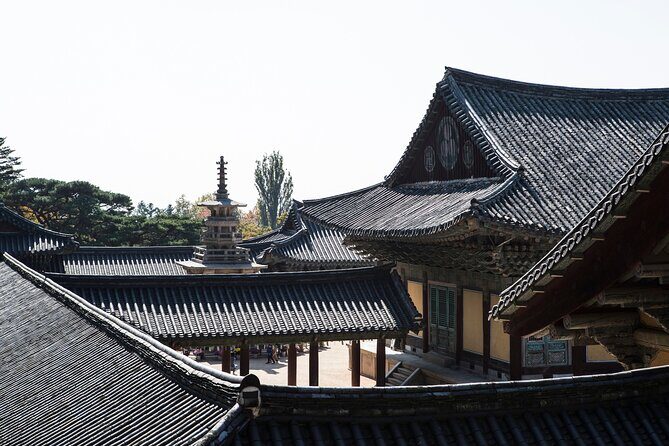
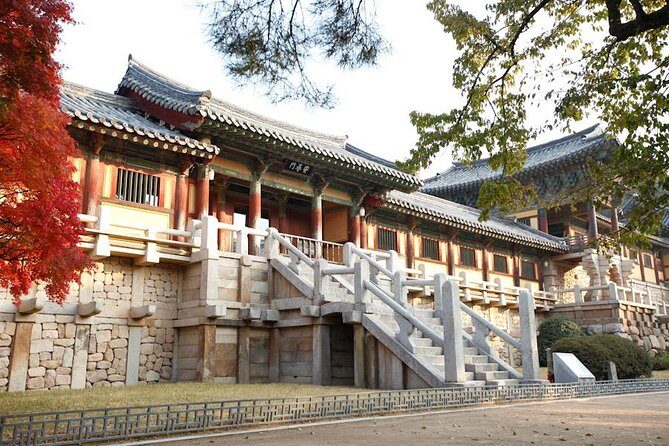
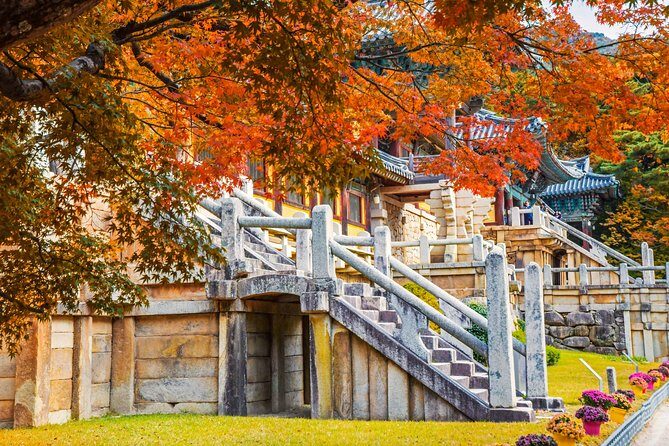
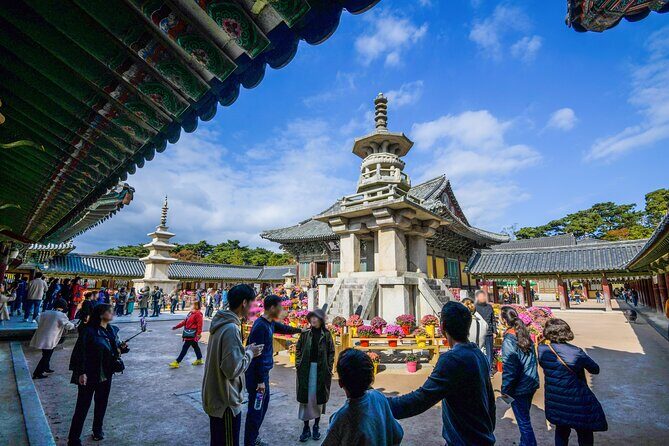
Your first major stop is Bulguksa Temple, a representative relic of Buddhist culture from the Silla kingdom. The temple complex traces back to construction in 528, during the reign of King Beop-Heung (514–540), and it was later rebuilt in 751 by Kim Dae-Seong. That’s a key context point: this place didn’t stay static, and the architecture reflects centuries of rebuilding and repair.
The temple also has a harder story. It caught fire during the Imjin War (1592–1598), after which it suffered serious damage and was even a target of robbers. That historical wrinkle makes Bulguksa more than a pretty setting—it turns it into evidence of persistence: faith, politics, and survival all tangled together.
You’ll have about 1 hour here, and admission is included. One practical consideration: even when you’re not doing a long hike, temple grounds can involve walking on uneven surfaces and shifting from shade to sun. Wear comfortable shoes and dress for the weather, because this is the type of day where you’ll be glad you did.
Stop 2: Daereungwon Tomb Complex and Cheonmachong’s 11,526 artifacts
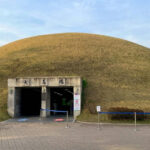
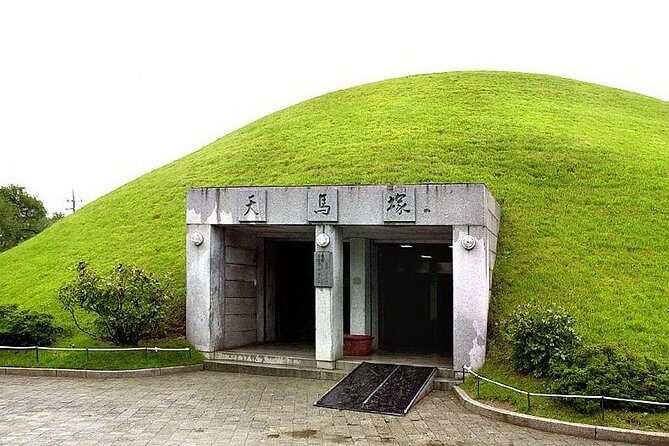
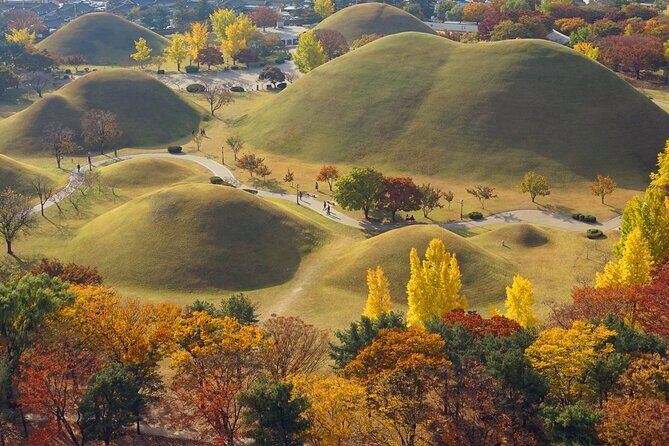
Next up is Daereungwon Tomb Complex, where the standout is Cheonmachong Tomb (Ancient Tomb No. 155). The tomb was excavated in 1973, and it’s a strong example of how the Silla elite approached funerary practice.
Here’s what makes Cheonmachong so memorable: there’s a wooden coffin placed inside an underground chamber, covered by a mound of boulders and earth. The tomb is massive—its mound is 12.7 meters high with a 50-meter diameter, and the rock layer includes rocks collected from streams. Below that rock layer is a wooden chamber about 6.5 meters long, 2.1 meters wide, and about 2.1 meters in height, with the wooden coffin centered inside.
And then there are the finds. A total of 11,526 artifacts were discovered within the tomb. One item gets special attention: Cheonmado, described as Korea’s first artwork excavated from an ancient tomb. That detail changes how you look at the site. Instead of just picturing a buried person, you’re thinking about what survived, what archaeologists found, and why those objects still matter today.
You’ll have about 1 hour here, and admission is included. This stop can feel heavy in tone compared to Bulguksa, so it helps that the route also includes a museum right after—because your brain needs a “bridge” from the tomb’s physical scale to the story the objects tell.
Stop 3: Gyeongju National Museum (free) to connect the artifacts to the sites
After the tomb complex, the Gyeongju National Museum is a smart pivot. The museum focuses on artifacts from the Silla dynasty, spanning 57 BC to AD 935. You’re also getting a real payoff from the timing because museum time turns what you saw into something you can understand.
The museum has had renovations, so galleries and exhibition halls have a newer layout. It also emphasizes community learning and improving management with an eye toward long-term cultural identity—small details, but it hints at why the museum feels more than a storage room for old things.
Admission here is free, and your time is about 1 hour. In a day trip schedule, one hour can sound short, but it’s usually enough when you’ve just visited a tomb site. You’ll likely find yourself spotting patterns: how objects connect to burial customs, how materials reflect status, and how the museum tells the “why” behind what’s buried outside.
If you’re the type who likes reading everything slowly, you may want to focus on key rooms first. With limited time, prioritize the displays that relate directly to Silla royal life and the kinds of items that match the tomb discoveries you just saw.
A few more Gyeongju tours and experiences worth a look
Stop 4: Cheomseongdae Observatory—astronomy as a 7th-century national treasure
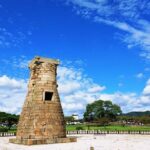
Last on the itinerary is Cheomseongdae Observatory. This is an astronomical observatory from the Silla period, and it’s described as the oldest surviving astronomical observatory in Asia (possibly the world). It was constructed in the 7th century, tied to Silla’s capital, Seorabeol, which is present-day Gyeongju.
What I like about this stop is how it gives you a different angle on “ancient culture.” It’s not only about religion or royal power. It’s also about measuring the sky and turning observation into knowledge. Cheomseongdae was designated as South Korea’s 31st national treasure on December 20, 1962, which tells you the importance has lasted well beyond the Silla period.
The story also links to regional influence. Cheomseongdae is modeled on Baekje’s Jeomseongdae, which now exists only in historical records. It’s also said to have influenced the Japanese Senseidai observatory in 675 and Duke Zhou’s observatory in China in 723. Whether you care most about the physics or the cultural exchange, you’ll walk away with a stronger sense that this corner of the world contributed to astronomy traditions.
You’ll have about 30 minutes here, with free admission. It’s short, so arrive ready to pay attention. If you want extra time, this isn’t the stop you should treat as optional—this is where your day ends with something fresh.
Time, food, and comfort: making the 9–10 hour day work
This trip runs about 9 to 10 hours, and it’s built around four stops plus rail time. That length is exactly why the private transport and tight routing feel useful: you don’t lose the day to commuting chaos.
But you should plan for what’s not included. Meals aren’t provided, so you’ll want to bring or buy something simple unless you’re fully comfortable with skipping. One practical approach is to eat before the first stop and then treat the day as a short-window schedule rather than a sit-down vacation meal. If you like lunch as a long break, you may end up feeling rushed.
The good news is that your time blocks are straightforward:
- Bulguksa: 1 hour
- Daereungwon: 1 hour
- Museum: 1 hour
- Cheomseongdae: 30 minutes
You also need moderate physical fitness, which is a polite way of saying expect some walking and standing. If you’re sensitive to long days, choose shoes you trust and keep water handy.
Weather also matters. The itinerary is subject to favorable conditions, and if it gets canceled due to poor weather, you should be offered an alternative site. That’s the right kind of contingency for an outdoor-heavy UNESCO day.
Finally: this is listed as non-refundable and cannot be changed. So if your dates are flexible, you may want to double-check your plans before committing.
Price and value: is $594.81 per person worth it?
At $594.81 per person, this isn’t the budget option. To me, it only makes sense if you value time and simplicity more than saving money.
Here’s where the price can feel justified:
- You’re getting private transportation and a driver/guide for multiple UNESCO stops in one day.
- You’re using KTX for the long distance quickly (and the whole day is built around that rail rhythm).
- The group is tiny: max 2 people, so you’re not paying premium rates for a crowd.
- Admissions for key sites are handled: Bulguksa and Cheonmachong/Daereungwon (per stop listings) include admission, and the museum plus Cheomseongdae are free.
Now the tradeoffs you should consider:
- Meals aren’t included, so you’ll spend a bit extra.
- The KTX train tickets are listed as not included, so make sure you’re not doubling costs in your head. The tour concept talks about prepaid round-trip tickets, but the included list says otherwise—confirm the exact ticket coverage in your confirmation.
- There’s no Seoul Station pickup/drop, so you’ll handle that leg yourself.
For the kind of traveler who hates logistics headaches—especially if your Korean is limited—this feels like “buy the calm.” For the solo ultra-budget traveler, it may feel expensive for one day. For couples or two friends who can share the cost and want a guided UNESCO sprint, it can feel like a smart use of money.
Who this Gyeongju UNESCO day trip suits best
I’d put this tour in the “serious day-tripper” category. It fits you if:
- you want a structured route with UNESCO depth in one day
- you prefer private pacing over group shuffle
- you’re okay with a long day and some walking
- you want help bridging language gaps at temples, tombs, and museum displays
It’s less ideal if:
- you want a slow travel day with no schedule pressure
- you rely on included meals or long café breaks
- you’re sensitive to non-changeable bookings and weather issues
If you’re traveling with a partner and want the itinerary to run like a checklist with context, this is a strong match.
Should you book Korail Day Trip to Gyeongju’s UNESCO sites?
Book it if you want an efficient, guided UNESCO day with minimal hassle, and you’re willing to pay for small-group attention and smooth transportation. The combination of Bulguksa, Daereungwon/Cheonmachong, Gyeongju National Museum, and Cheomseongdae is a smart lineup—temple, tomb, artifacts, and astronomy—so your day feels complete rather than repetitive.
Don’t book it if your main goal is saving money or if you’re not ready for a full 9–10 hour day without meals included. Also, double-check that your KTX train tickets are truly handled in your booking, because the tour materials are a bit mixed on that point.
If your dates are firm, your walking tolerance is decent, and you want Gyeongju’s UNESCO highlights with a guide steering the meaning, this is the kind of day trip that can feel like a real payoff.
FAQ
How long is the day trip?
It’s about 9 to 10 hours, depending on the timing of the rail and site visits.
Is this tour private?
Yes. It’s a private tour/activity, and only your group participates. The maximum group size is 2 people per booking.
Where does pickup and drop-off happen in Gyeongju?
Pickup and drop-off are at SinGyeongju Station. The experience also ends back at the meeting point, which is Gyeongju Station.
Which UNESCO sites are included?
The itinerary includes Bulguksa Temple, Daereungwon Tomb Complex (with Cheonmachong Tomb), Gyeongju National Museum, and Cheomseongdae Observatory.
Are admission tickets included?
Admission tickets are included for Bulguksa Temple and for the tomb complex stop. Admission is free for Gyeongju National Museum and for Cheomseongdae Observatory.
Are meals included?
No. Meals are not included.
Do I need KTX train tickets?
KTX train tickets are listed as not included. The tour is built around the KTX route, so confirm whether your booking includes the train tickets you need.
What’s the fitness level requirement?
You should have a moderate physical fitness level, since you’ll be walking and spending time at multiple sites.