REVIEW · SEOUL
Closest Observatory to DMZ & Suspension Bridge Tour from Seoul
Book on Viator →Operated by I Love Seoul Tour · Bookable on Viator
You’ll stand close to the DMZ story. This tour pairs Aegibong Peace Eco Park with Jogang Observatory in the Civilian Control Zone, including a stop at the observatory’s Starbucks and views toward North Korea from about 1.4 km away. I especially like the human-scale history of Hill 154 and the way the tour frames the peace symbolism of the site, not just the photo opportunity. One thing to consider: passports are mandatory, and the whole outing depends on good weather.
The best part is the guide-led context. Guides like Sunny, Thomas, and Shin are praised for clear, friendly explanations that make the South–North divide easier to grasp while you’re actually standing in the landscape shaped by it. The day runs about 4 hours 45 minutes, and it ends back at Myeong-dong Station, so it’s easy to plug into your Seoul schedule without losing half the day to logistics.
In This Review
- Key highlights at Aegibong and Jogang
- Why Aegibong and Jogang feel so close to the DMZ
- Meeting in Myeong-dong and making sense of the 4h45 schedule
- Aegibong Peace Eco Park: Hill 154, displaced families, and the Christmas-tree lesson
- Jogang Observatory: the 1.4 km view and what to expect when you look
- The Starbucks at the observatory: a useful break, not the whole point
- Guides make or break this kind of tour (Sunny, Thomas, Shin)
- What to bring, what to watch for, and who this suits
- Price and value: $48 for a rare viewpoint
- Should you book the closest observatory tour from Seoul?
- FAQ
- Do I need a passport for this tour?
- Where does the tour start and end?
- How long is the tour?
- How much does it cost?
- Is the tour guided?
- Is coffee at the Starbucks included?
- What happens if the weather is poor?
Key highlights at Aegibong and Jogang
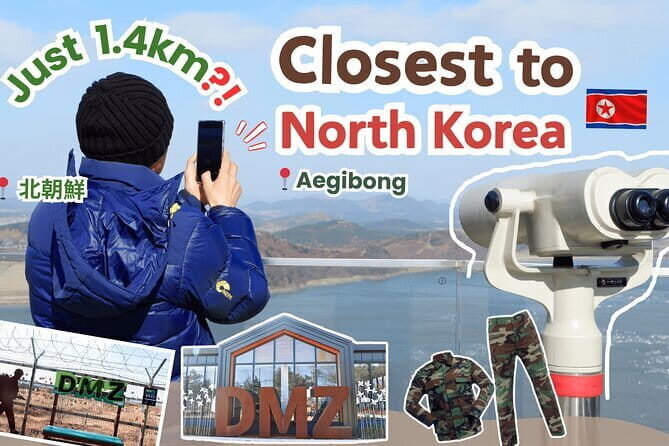
- 1.4 km North Korea viewpoint from Jogang Observatory, one of the closest public-looking angles from the South
- Aegibong Peace Eco Park on former Hill 154, where the Korean War hit hard at this river junction area
- A Starbucks stop at the observatory, included as a chance to grab a drink on-site (coffee itself is not included)
- Peace-and-harmony symbolism, plus the story of the Christmas-tree lights being removed after conflicts
- Passport-required outing with a guided, structured route from central Seoul (Myeong-dong)
Why Aegibong and Jogang feel so close to the DMZ
Aegibong and Jogang aren’t just “DMZ-adjacent.” They sit inside the tension line of Korean War history and post-war longing. The site you visit was originally Hill 154, a place where fighting was fierce, located where the Hangang River meets the Jogang River area. That matters because the park isn’t presented like a generic attraction. It reads like a map of how people lived through separation, return fantasies, and the long wait after the guns cooled down.
What I like most is that the tour doesn’t treat the boundary as a thrill ride. It gives you context: Aegibong became famous for displaced people who came to look for their hometowns after the Korean War. Then the observatory angle turns that memory into a literal line of sight—so your photos feel tied to meaning, not just distance.
The second big plus is the Jogang Observatory itself. The tour’s core hook is that you can see northern land from the observatory at a close distance—listed as about 1.4 km. Whether you’re a history nut or just curious, that number lands in your head fast. You’re not imagining; you’re there, looking across one of the most guarded divisions on Earth.
You can also read our reviews of more tours and experiences in Seoul.
Meeting in Myeong-dong and making sense of the 4h45 schedule
This is a “get on the bus and go” style tour. You start in Myeong-dong (Jung District) and the tour ends back at Myeong-dong Station, which is practical because it keeps you near transit, food, and your evening plans.
The duration is about 4 hours 45 minutes. That’s long enough to feel like a real excursion, but not so long that it crushes your Seoul day. Expect a rhythm of travel time, a longer stop at Aegibong, then additional time up at the observatory area, before returning to the city.
The tour includes an air-conditioned vehicle, which helps because you’ll be in and out of viewing areas and weather conditions can change quickly. The max group size is up to 120 travelers, so you’re not going to feel like you’ve rented the place. You’ll likely be grouped and managed efficiently.
If you’re the kind of person who likes to understand schedules early: the eco-park stop is listed as 1 hour 30 minutes with admission included. That gives you enough time to walk the grounds at an unhurried pace, read key displays, and still make it to the observatory portion without rushing.
Aegibong Peace Eco Park: Hill 154, displaced families, and the Christmas-tree lesson
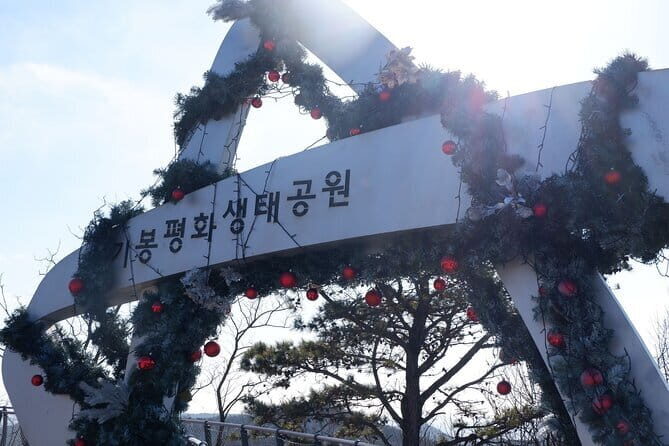
Your first major stop is Aegibong Peace Eco Park. It’s the kind of place where the walking makes sense: you’re moving through the layers of story attached to the ground.
Start with Hill 154. The park’s origin in the Korean War gives it weight. This wasn’t a quiet hillside that later became scenic; it was part of the fighting map. When you remember that, the rest of the park’s message lands differently.
Then come the displaced people stories. Aegibong is described as famous for being a place displaced families often visited after the war, when they missed their homes and wanted to see their hometowns again. It’s a simple idea with heavy emotion behind it. You’re looking outward, hoping to find something familiar across distance.
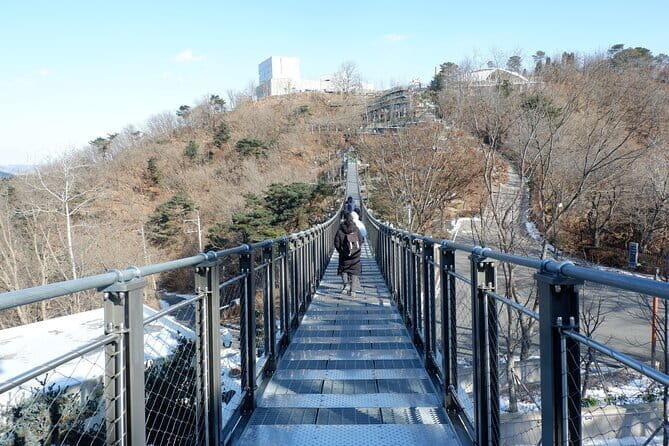
And yes, there’s a very specific, very human detail that turns history into something you can picture: the park used to be known for a huge Christmas tree. The lights were removed because they were considered too bright toward North Korea, and it caused conflict linked to electricity limits in North Korea. After that, the park workers built bridges in the shape of the tree.
I appreciate that twist. It doesn’t erase the earlier symbol; it shows adaptation—people trying to keep meaning while reducing harm. Even if you don’t care about Christmas trees (I’m not here to judge), that story explains why the park feels carefully managed and why the theme is explicitly peace and harmony.
Practical tip: you’ll probably want to arrive with comfortable shoes. The park is built around walking and viewpoints, and you’ll get more out of it if your legs aren’t counting minutes.
Jogang Observatory: the 1.4 km view and what to expect when you look
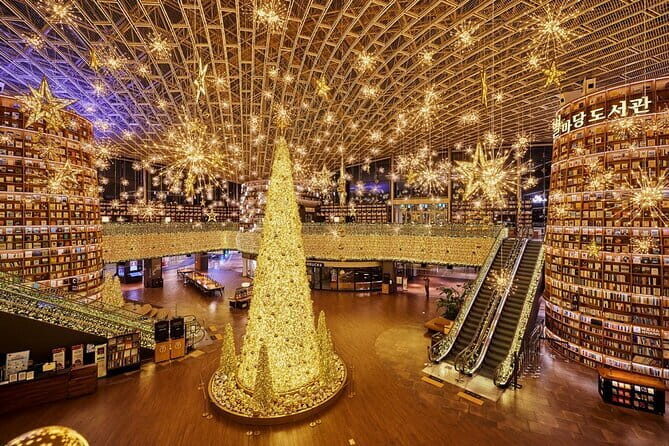
After Aegibong, you’ll go to Jogang Observatory in the Civilian Control Zone. This is the main reason to choose this tour if your goal is seeing the North from the closest public-facing distance described here.
The observatory has its own timeline. The old observatory was established in 1978, then later demolished and renewed under the name Jogang Observatory. The important part for your day is what it offers: a view of northern land from a close distance.
Also, the tour description calls out proximity: North Korea is listed as about 1.4 km away from this observatory viewpoint. That’s the kind of detail that makes you slow down. Even if you can’t see anything dramatic at first glance, the act of looking from a specific spot matters. You’re aligning your eyes with a real, measured distance.
And this is where the guide context really earns its keep. Standing at a boundary site without explanation can turn into guesswork: you’ll wonder what you’re actually looking at, and why the site is handled the way it is. The guides highlighted in feedback—Sunny, Thomas, Shin—are praised for making the South–North conflict easier to understand in the moment. That’s useful, not just “nice.”
One more note: your experience here is sensitive to real-world conditions. The tour is described as requiring good weather, so if visibility is poor or conditions are unsafe, the operator may change dates or offer a refund. That’s not a minor footnote. It’s a core part of the value of the observatory stop.
The Starbucks at the observatory: a useful break, not the whole point
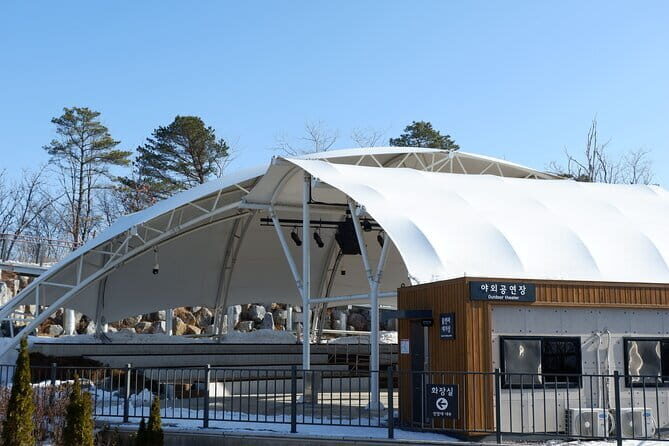
There’s a Starbucks on the observatory grounds, and it’s clearly part of what makes this outing stand out. But the smart way to approach it is simple: treat it as a practical stop, not the main event.
Coffee at Starbucks here is not included. So budget for a drink if you want it. That said, having access to something familiar can be a lifesaver on a structured day where you may be moving between zones and viewpoints.
The more interesting angle is how the Starbucks is folded into the peace-site story. The tour frames it as part of the current observatory experience at Aegibong, right where the displaced families story lives. In other words: you’re looking across separation, and you can buy a café drink while you do it. That contrast is part of why the stop works.


Guides make or break this kind of tour (Sunny, Thomas, Shin)
Tours in sensitive areas live or die by explanation. This one has that advantage. In the feedback you can trust, the guides get repeated praise for being friendly, organized, and good at communicating clearly.
Names that come up include:
- Sunny: highlighted for engaging, caring communication and strong organization
- Thomas: praised for being helpful and friendly, with clear explanations of the South–North Korea conflict
- Shin: praised for being one of the most informative guides people have had
There’s also a useful theme in the feedback: guides connect the political conflict to being South Korean and how division shows up in everyday understanding. If you’re trying to grasp the DMZ not as a headline but as something that shapes identity, that style of explanation is exactly what you want.
Practical suggestion: when you’re on the bus and before you reach the observatory, listen closely to the guide’s setup. Those short bits often tell you where to look, what to pay attention to, and how to avoid getting stuck on the wrong details.
What to bring, what to watch for, and who this suits

This tour runs with strict documentation requirements. Passports are mandatory. Bring your passport and make sure it’s in hand on the day. This isn’t “bring a photo.” It’s the real thing, because the tour explicitly requires passports.
Physical fitness: the tour suggests a moderate physical fitness level. That doesn’t mean you need to train for a mountain. It does mean expect walking on uneven areas, standing time at viewpoints, and some steps between areas.
Tickets: you’ll use a mobile ticket, which is convenient, and there’s a note about group discounts. If you’re traveling with friends, it can add up.
Who it suits best:
- You want a guided, structured DMZ-adjacent outing without the stress of piecing together multiple stops
- You care about history and context, not just sightseeing
- You’re comfortable following rules in a tightly managed area (passport checks, weather dependency)
Who might find it less ideal:
- If you don’t have a passport ready, or you’re not willing to follow document rules, skip it
- If you hate bus days or get impatient with group scheduling, the max group size of up to 120 could feel big
Price and value: $48 for a rare viewpoint
At $48 per person, this isn’t cheap in “Seoul sightseeing” terms, but it also isn’t priced like a private charter. For what you’re getting—transport from central Seoul, a guided experience (if you select that option), and a major viewpoint tied to the DMZ story—it can feel like good value, especially if you’re comparing against other structured half- or full-day excursions.
The big “value lever” is the observatory distance angle. 1.4 km is the headline detail. That kind of access is not common in Seoul. You’re paying for a controlled route and a chance to see northern land from a close, specific viewpoint.
What’s included:
- An air-conditioned vehicle
- Admission ticket included for the eco-park stop
- Passport requirement handling (requirements for passports)
- A professional tour guide (only if you choose the guide option)
What’s not included:
- Coffee/tea (including the Starbucks coffee)
- Snacks, lunch, travel insurance
- Hotel pickup/drop-off (meeting is in Myeong-dong)
That last line matters for budgeting. If you’ll need food or drinks, plan to cover that yourself. Bring a light snack if you’re the type who gets hungry during viewpoint time.
Should you book the closest observatory tour from Seoul?
I think it’s worth booking if you want one focused day that mixes history, meaning, and a rare view. The combination of Aegibong Peace Eco Park (Hill 154 history, displaced families, peace symbolism) and Jogang Observatory (close-distance northern land viewing) is the appeal, and the guide-led explanations are a real strength.
Book it if:
- You can present a passport
- You’re traveling on days likely to have good weather
- You like context that makes your photos feel grounded
Skip it if:
- You’re missing a passport or don’t want to deal with document checks
- You need a flexible plan that doesn’t depend on weather for your main highlight
If you do book, go in with the right mindset: you’re not just collecting a view. You’re walking through a place where separation and peace are written into the ground.
FAQ
Do I need a passport for this tour?
Yes. Passports are mandatory for this experience.
Where does the tour start and end?
The tour starts in Myeong-dong, Jung District, Seoul and ends at Myeong-dong Station.
How long is the tour?
It runs for about 4 hours 45 minutes (approx.).
How much does it cost?
The price is $48.00 per person.
Is the tour guided?
A professional tour guide is included if you select that option. The tour also requires a passport as part of the experience.
Is coffee at the Starbucks included?
No. Coffee and/or tea are not included. You can buy it at Starbucks, but it’s not part of the package.
What happens if the weather is poor?
The experience requires good weather. If it’s canceled due to poor weather, you’ll be offered a different date or a full refund.