REVIEW · SEOUL
Bukhansan National Park: The Summit Course
Book on Viator →Operated by Sam LEE · Bookable on Viator
Seoul has a real summit hike. This Bukhansan National Park route targets Baek-un-dae, the highest peak in Seoul, and lets you feel seasonal changes up close. The whole point is getting you to the top without turning your day into a long, exhausting trudge.
I love the way this course focuses on the fastest practical route, aiming for about 4 hours to reach the summit instead of the usual 6. I also love the safety-first guidance during the steeper parts, led by Koa and Sam, with clear support for a group of up to 20.
One big consideration: this hike is not recommended for people with knee issues, and the climb is steep enough that you need moderate fitness to handle it comfortably.
In This Review
- Quick hits
- Bukhansan National Park: why a guided summit hike is worth your morning
- Route math you’ll feel: 600 meters of gain in a short distance
- Baek-un-dae peak: the rope-assisted section and how to manage it
- How the guides keep the day moving: Koa and Sam’s small-group pacing
- Timing that makes sense: a 4.5-hour experience designed for real work
- Meeting point and getting there: Bukhansan UiSeoul and a smooth start
- Poles, knees, and what to do if your legs are the weak link
- Optional tofu lunch after the summit: what you can eat and who it suits
- Value for your money: $64.89 and what you’re really paying for
- Weather and risk management: why good conditions matter here
- Who should book this summit course (and who should skip it)
- Should you book this tour?
- FAQ
- How long is The Summit Course in Bukhansan?
- What time does the hike start?
- Where do we meet and where does the tour end?
- Is lunch included?
- What fitness level do I need?
- Is the tour suitable for people with knee issues?
- Is there a steep or rope-assisted section?
- Can I avoid the rope-assisted part if I’m uncomfortable with heights?
- Are hiking poles included?
Quick hits
- A faster summit plan: target around 4 hours to reach Baek-un-dae
- Real elevation work: about 600 meters of gain in 2.1 km
- Rope-assisted steep stretch: a 25 to 45 degree section near the top
- Small-group feel: maximum 20 people, paced by the guides
- Optional tofu lunch: vegan-friendly spot after you finish
Bukhansan National Park: why a guided summit hike is worth your morning
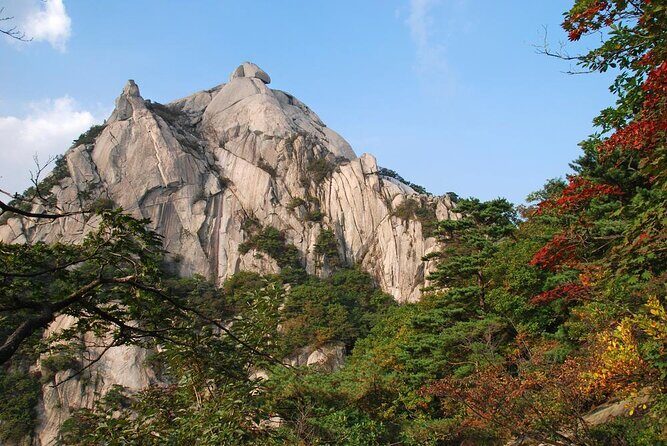
Bukhansan National Park sits right by Seoul, so it feels close to the city but still delivers that full-on mountain day. You’ll be climbing to the highest point in Seoul, 836 m (2,743 ft), and you can really sense the seasons changing as the trail goes from city edge to serious hillside.
This is not a casual stroll. The whole experience is built around a sensible goal: get to the summit and back with a route that saves time while still tackling the elevation honestly.
You can also read our reviews of more tours and experiences in Seoul.
Route math you’ll feel: 600 meters of gain in a short distance
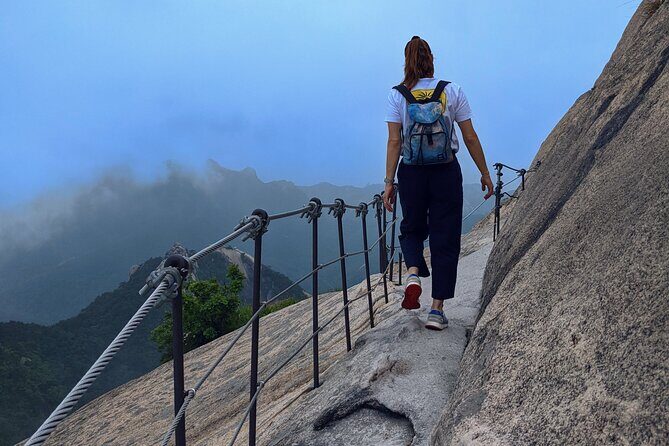
The core climb is steep. You’re looking at roughly 600 meters (about 2,000 ft) of elevation gain within 2.1 km (1.3 miles). That kind of pitch is the difference between I can do this and I’m regretting life choices.
On a typical climb, that ascent can take around 100 to 120 minutes. This course doesn’t magically remove the climb, but it aims to get you through it with smarter pacing and the simpler route the guides research for your group. In plain terms: you’ll work hard, but you’re not wandering.
Moderate fitness is the line. If you can handle sustained uphill effort, you’re in the right zone. If stairs and steep grades make your legs feel loud, this may be a stretch.
Baek-un-dae peak: the rope-assisted section and how to manage it
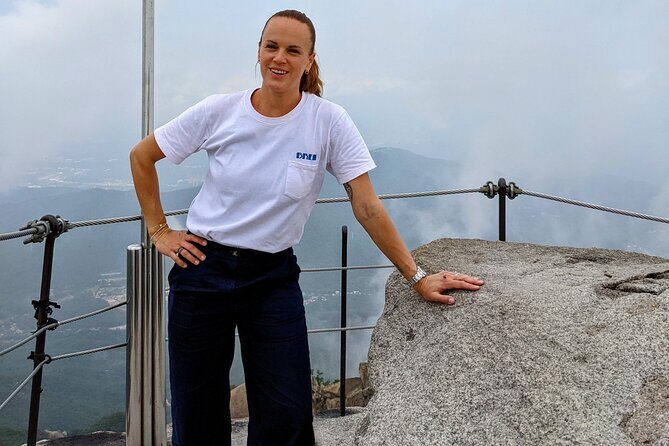
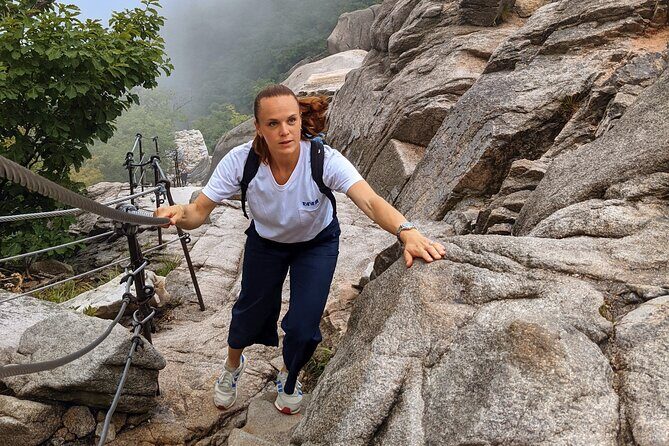
The standout moment is reaching Baek-un-dae. Before you get that summit payoff, you’ll hit a more technical section near the top: around 25 to 45 degree-angle climbing. Ropes are used to help you through it.
Time matters here. You’re looking at about 20 to 30 minutes in that harder segment. If you have fear of heights, you can take it slower or avoid that part by having a break, based on how the course is run.
The practical takeaway: this tour doesn’t pretend everyone feels the same about steep exposure. The guides, including Koa and Sam, are praised for focusing on safety first while keeping the hike fun. That combination matters when the terrain gets serious.
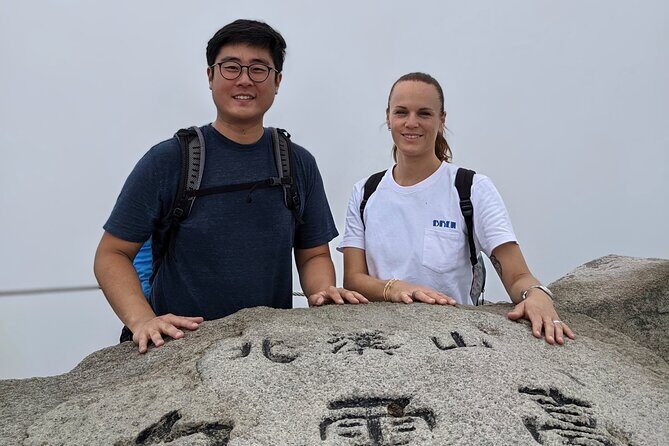
And yes, the view is the reward. The reviews are consistent: once you’re up there, the steep work feels worth it.
How the guides keep the day moving: Koa and Sam’s small-group pacing
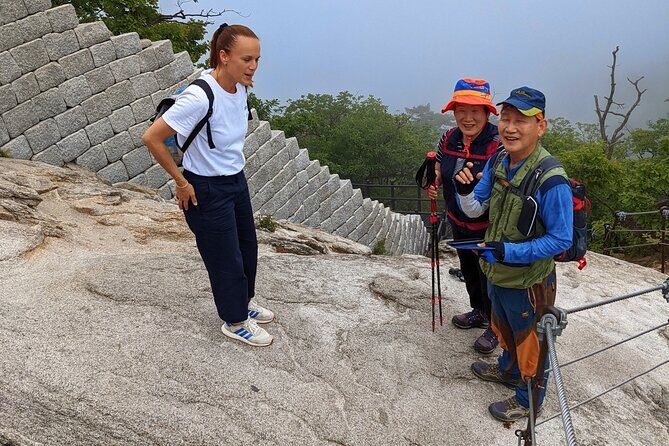
This course runs with a max of 20 travelers, which is key. In a big crowd, steep sections can turn into bottlenecks. In a smaller group, the guides can adjust pacing, help people keep footing, and keep everyone from getting strung out too far behind.
Koa and Sam are specifically highlighted for being flexible and knowledgeable, and for making sure participants stay safe while still enjoying the moment. One of the best things about their approach is that they’re not just moving you along. They’re actively managing the group energy, so you’re not stuck waiting at the wrong times or rushing in the wrong places.
The start time is early: 8:00 am. That helps you get the hike done before the day gets busy, and it also fits the rhythm of a mountain morning—less crowds and better odds of calm conditions.
Timing that makes sense: a 4.5-hour experience designed for real work
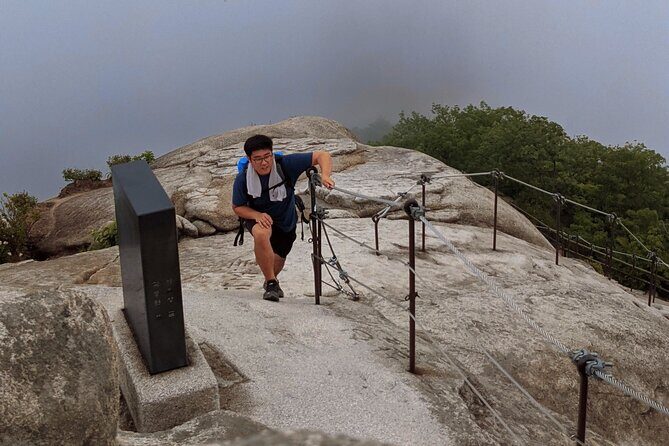
The total duration is about 4 hours 30 minutes. The reason the hike doesn’t balloon is the structure: the summit course targets around 4 hours to the peak using the simplest route found through research, rather than the longer 6-hour standard.
That time-saving piece is the value. When you’re in Seoul, you’ve already got limited daylight and a lot of competing plans. A guided route that avoids needless wandering means you still get the summit experience, without burning your entire day in transit and trial-and-error.



Meeting point and getting there: Bukhansan UiSeoul and a smooth start
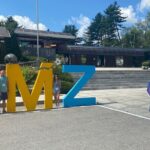
You start at Bukhansan UiSeoul, South Korea, and the hike ends back at the same meeting point. That’s a simple setup with a big payoff: no complicated end-of-day logistics.
The meeting location is near public transportation, which matters if you don’t want to spend your morning figuring out how to reach a trailhead. It also makes it easier to pair this hike with other Seoul plans afterward.
You’ll also get a mobile ticket, which is convenient if you’re already juggling transit cards, reservations, and a phone full of maps.
Poles, knees, and what to do if your legs are the weak link
Hiking poles can be rented, but there’s a catch: they’re only rentable if you inform in advance, and there’s an extra cost. The guides also note that poles aren’t really necessary unless you have bad knees.
That sounds contradictory until you think about the idea of optional support. Poles are mainly useful on steep descents and when your joints get unhappy. But if you already know your knees get cranky, you should pay close attention—this hike is explicitly not recommended for knee issues.
So here’s the honest way to think about it: if your knees are usually fine, poles are optional support. If your knees aren’t fine, don’t treat this as a workaround tour.
Optional tofu lunch after the summit: what you can eat and who it suits
You have an optional lunch after the hike. It’s not included, and it’s paid by individuals, typically 9,000 to 15,000 KRW. The plan is to eat at a place specializing in tofu dishes, made from scratch. They also have meat options, which is handy if you’re traveling with mixed eating styles.
For plant-based eaters, that tofu focus makes this easier than many mountain spots. The information also notes it’s vegan/vegetarian friendly, so you shouldn’t need a separate plan if you eat that way.
A small practical note: lunch is optional, so your energy at the end matters. If you’re cooked after the rope section, you might simply want food and a sit-down moment.
Value for your money: $64.89 and what you’re really paying for
At $64.89 per person, this isn’t a budget-only hike. The value comes from what you’re buying: research-backed route choices, a safety-oriented guide team, and a time plan that aims for about 4 hours to reach the summit.
If you were doing this on your own, you’d likely spend time sorting out the best route, then still face the decision-making in the hardest sections. Here, that work is handled for you. You also get a small-group experience with up to 20 people, plus the option to rent poles if you set it up early.
Also factor in the peace of mind. The mountain sees rescues every year—so this isn’t just “a popular hike.” It’s a popular hike where the terrain demands respect. Paying for a guide can be the difference between enjoying the mountain and fighting it.
Weather and risk management: why good conditions matter here
This experience requires good weather. If it’s canceled due to poor weather, you’ll be offered a different date or a full refund. That’s important for a route with steep elevation and a rope-assisted section.
If you’re planning your trip around fixed dates, keep in mind this hike is time-sensitive: you start at 8:00 am, and conditions can change quickly around mountains. The smartest move is to treat it like a weather-dependent activity, not a guaranteed checklist item.
Who should book this summit course (and who should skip it)
This hike fits best if you want a real mountain day without the guesswork. If you like hiking and you can handle steep uphill effort, you’ll likely enjoy the challenge and the short path to the summit.
It’s a good match for people who:
- Want a faster route to the highest peak in Seoul
- Prefer a guided approach with safety support in the steepest area
- Like the idea of a structured morning: 4.5 hours, then optional lunch
It’s not a good match if you:
- Have knee issues (explicitly not recommended)
- Strongly fear heights and are uncomfortable with rope-assisted climbing without the option to pause or avoid that segment
Should you book this tour?
Book it if you want Baek-un-dae, but you don’t want to gamble with route planning or safety on steep terrain. This course is built for efficiency and controlled pacing, and the small-group size helps the guides manage people well.
Skip it if your knees don’t tolerate steep descents or if the rope-assisted section sounds like a deal-breaker for you. In your case, the risk of turning a fun hike into a painful one isn’t worth it.
If you’re in the middle—moderately fit, comfortable with steep grades, and ready for a rope-supported challenge—this is a strong choice. You’ll be spending your morning doing something real just outside the city, and when you reach the top, the view is the payoff.
FAQ
How long is The Summit Course in Bukhansan?
It runs for about 4 hours 30 minutes.
What time does the hike start?
The start time is 8:00 am.
Where do we meet and where does the tour end?
You meet at Bukhansan UiSeoul, and the tour ends back at the same meeting point.
Is lunch included?
No. Lunch is optional and paid by individuals after the hike (about 9,000 to 15,000 KRW).
What fitness level do I need?
You should have a moderate physical fitness level.
Is the tour suitable for people with knee issues?
It is not recommended for people with knee issues.
Is there a steep or rope-assisted section?
Yes. The Baek-un-dae peak area includes climbing aided by ropes, with a steep 25 to 45 degree-angle section lasting about 20 to 30 minutes.
Can I avoid the rope-assisted part if I’m uncomfortable with heights?
If you have a fear of heights, this 20 to 30 minute part can be avoided by having a break.
Are hiking poles included?
Hiking poles can be rented, but it costs extra and you must inform the provider in advance. They are not really necessary unless you have bad knees.